
The US Department of State has signed a Memorandum of Understanding with the Ultimate Fighting Championship (UFC) to launch a public-private partnership aimed at advancing sports diplomacy worldwide. This initiative will leverage UFC's extensive global platform and athletes to engage international audiences, promote cultural exchange, and champion American values such as discipline and perseverance.
The US Department of State has signed a Memorandum of Understanding with the Ultimate Fighting Championship (UFC) to launch a public-private partnership aimed at advancing sports diplomacy worldwide. This initiative will leverage UFC's extensive global platform and athletes to engage international audiences, promote cultural exchange, and champion American values such as discipline and perseverance.

'India is trying to project that it can engage with the world in a different way too.'

The Samosa Caucus, an informal group of Indian-American lawmakers, is set to expand its presence in the US House of Representatives following the recent elections. With Democrats gaining control of both the House and Senate, re-elected members like Ami Bera, Ro Khanna, Suhas Subramanyam, and Pramila Jayapal will be joined by newcomers Pia Dandiya and Amish Shah, significantly increasing Indian-American representation on Capitol Hill.
Indian-American Democratic lawmakers Ami Bera, Ro Khanna, Suhas Subramanyam, and Pramila Jayapal have been re-elected to the US House of Representatives, with Pia Dandiya making her debut, marking a strong showing by the community in the recent midterm elections where Democrats gained control of both the House and Senate.

Some 73 speakers assembled on October 26 and 27 at the Raffles University at Neemrana in Rajasthan, a few with clearly tenuous ties with diplomacy, but were deemed to add value to the proceedings, notes Krishnan Srinivasan.

India's Indo-Pacific approach has traditionally emphasised strategic autonomy, ASEAN centrality, freedom of navigation, respect for international law and an inclusive regional order. Its growing defence and maritime partnerships with Australia, Japan, Indonesia, Vietnam and other Southeast Asian countries provide additional depth to this approach, point out Dr Kumar and Dr Jasmeet Kaur.

External Affairs Minister S Jaishankar has publicly acknowledged India's intensified diplomatic efforts to resolve the Ukraine conflict, engaging directly with both Kyiv and Moscow. India is focusing on critical issues like Black Sea shipping safety, grain exports, and energy supplies, moving beyond its previous advocacy role. Jaishankar also highlighted India's historical ties with Russia and discussed the evolving global geopolitical landscape, including the repositioning of the US and the rise of China.

New Delhi must look for formal, institutional statements issued directly from Washington rather than rely on casual pronouncements meant for local audiences, notes Ambassador Rajasekhar.

India is deeply concerned by the growing consolidation of Pakistan-backed jihadi and radical Islamist groups in Bangladesh, particularly in the strategically vital Chittagong Hill Tracts, which experts warn is transforming the country into a new safe haven for these networks and posing a direct threat to India's security.

A top Swiss official has emphasised the growing importance of science and technology in international affairs, leading Switzerland to prioritise anticipatory science diplomacy in its foreign policy. Collaboration with India reflects a shared vision between two global innovation leaders.
The Ministry of External Affairs stated that India's participation in the 2027 SAF Games in Pakistan will be guided by the sports ministry's policy, which permits Indian athletes to compete in events with Pakistani participants and vice-versa. Separately, the MEA also commented on the ongoing legal proceedings for seven foreign nationals, including a US citizen and six Ukrainians, who were recently chargesheeted by the NIA for illegal entry and movement, though not under UAPA at this stage.

US Vice-President J D Vance's unexpected phone call to Prime Minister Narendra Modi on August 8 has ignited speculation about a potential diplomatic overture, possibly seeking India's support amidst the escalating US-Iran conflict and a shifting global power landscape, suggests Ambassador M K Bhadrakumar.

Pakistan Prime Minister Shehbaz Sharif expressed 'forever grateful' to US President Donald Trump for his 'timely' intervention in securing a ceasefire with India following a military conflict last year, a claim India has consistently rejected.

India has strongly protested to the United States after three merchant ships with Indian crew members were attacked by the American military off the coast of Oman, resulting in the deaths of three Indian nationals.

Iran's Deputy Foreign Minister Kazem Gharibabadi confirmed a peace deal with the United States, stating that Tehran will enter a 60-day negotiation period only after verifying Washington's commitments to ending hostilities, lifting the blockade, and releasing Iranian assets.

Taking to Truth Social on Monday evening, Trump reposted Gor's original Sunday night dispatch alongside a video snippet from the grand celebrations marking the 250th anniversary of America's independence, hosted at the iconic Bharat Mandapam in the national capital.

India's position appears to be anchored around three red lines: Hasina's safety and the guarantee of a fair trial; assurances that Bangladeshi territory will not be used for activities hostile to India; and the restoration of an inclusive democratic process in Bangladesh.

'The flip side of this is that he won't hesitate to call out India if he thinks its policies are hurting US economic interests or border US foreign policy goals.'
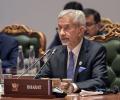
India has expressed serious concerns about the West Asia crisis and its potential impact on energy supplies and maritime stability, urging BRICS nations to find practical solutions to geopolitical challenges and unilateral sanctions.
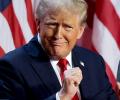
US President Donald Trump announced that a deal to end the war with Iran would be signed on Sunday, with the strategic Strait of Hormuz immediately becoming 'open to all'. This follows indications from Pakistan that negotiations were in their final stages, though Iran has yet to comment on the timeline.

If Trump doesn't like India, that is his choice. But to use such distasteful language on a public platform is deeply offensive and needs to be called out, points out Amberish K Diwanji.

Prime Minister Narendra Modi and US Secretary of State Marco Rubio discussed various aspects of India-US bilateral ties, focusing on defence, trade, energy, and technology. Rubio extended an invitation from President Donald Trump for PM Modi to visit the US.

History may remember Takaichi Sanae not as the leader who simply accelerated Japanese rearmament, but as one who governed during Japan's transition from an industrial-age security model to a post-industrial strategic member of the global order, points out Varun Arya.

India would confront a more entrenched China, a less dependable United States, and a regional order increasingly shaped by great-power bargaining over which it exercises limited influence, notes Amberish K Diwanji.

In the Indo-Pacific's new era -- where perception shapes reality faster than treaties -- the real entrapment is not of China or the United States. It is the test Japan has set for itself -- and whether partners like India, acting as balancers rather than accelerants, can help ensure that the story ends in stability, points out Varun Arya.

US Vice President JD Vance is set to arrive in Islamabad on Monday evening to lead a high-level American delegation in a second round of ceasefire negotiations with Iran, CNN reported, citing White House on Sunday.

The Dhurandhar movies will undoubtedly shape the minds of the audience much more than news reports, court investigations, books and documentaries. But it is worth remembering that Pakistan's irridentist claims against India's national security have succeeded due to strategic planning, diplomacy, and the unsung heroines and heroes across government agencies, not due to a single maverick leader, points out Shweta Desai.But it is worth to remember that Pakistan's irredentist claims against India's national security have succeeded due to strategic planning, diplomacy, and the unsung heroines and heroes across government agencies -- not a single maverick, points out Shweta Desai.

Congress leader Shashi Tharoor discusses India's role in the US-Iran peace talks taking place in Islamabad, emphasising the importance of peace over competition with Pakistan and highlighting India's regional interests.

As Iran heads into crucial peace talks with the United States of America, here are the six men who decide the Islamic Republic's course.
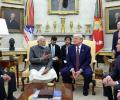
'As one former Indian diplomat put it to me, Delhi has access to the White House, but Islamabad has access to Mar-a-Lago.'

Pakistan is set to host face-to-face talks between the United States and Iran, aiming to solidify a fragile ceasefire and prevent further conflict in West Asia. The discussions will focus on a long-term peace arrangement, including sanctions relief, regional security, and Iran's nuclear program.

The pause gives the US time to breathe, to regroup, to move its expeditionary force into position without risk of interception along the way. It gives Iran nothing -- on the ground, attacks against its infrastructure continue apace. Prem Panicker in his must read daily blog on the Gulf War.

An Iranian delegation, led by Foreign Minister Abbas Araghchi, is expected to arrive in Islamabad for the second round of peace talks with the US, according to Pakistani media reports. This follows a phone call between Deputy Prime Minister Ishaq Dar and Araghchi regarding the US-Iran ceasefire and Pakistan's diplomatic efforts.

Chaffing under public ridicule in the US as well as internationally for having 'lost' the war, Trump is under immense pressure to do something, cautions Ambassador M K Bhadrakumar.

The LPG squeeze on India's restaurant sector is the quotidian face of a deeper crisis.

'Nepal today is far more aware, self-confident, aspirational, and assertive.' 'India's policy so far has not been geared to this shift. It is time to redraw our Nepal strategy.'

'It is best to remain vigilant. Tarique Rahman arranged arms smuggling to Indian insurgent groups.' 'He has criticised India for sheltering Sheikh Hasina, but has also sought India's support.'

Iran launched retaliatory military strikes targeting Israel and American military bases across the region, including in Qatar, the United Arab Emirates, Kuwait, Bahrain and Jordan.
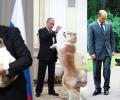
Animal companions are often excellent publicity vehicles for politicians and leaders.
